|
Villa La Foce and its farm are located in the crete senesi (clay hills of Sienna) overlooking the Val d'Orcia, in southern Tuscany. Pienza, Montepulciano, Monticchiello and Montalcino are only a few miles away. La Foce is located near the site of an Etruscan settlement and a burial-place dating from the 7th century BC to the 2nd century AD has been excavated on the property. La Foce has been continuously inhabited for many centuries and being situated on the Via Francigena increased its significance. The Villa itself was built in the late 15 C as a hospice for pilgrims and merchants traveling on the via Francigena.
Villa La Foce from the garden
In 1924 the property was bought by Antonio Origo and his Anglo-American wife Iris, the daughter of Lady Sybil Cutting, the owner of Villa Medici at Fiesole where Iris Origo spent much or her early life. They dedicated their lives to bringing prosperity and cultural and social changes to this formerly poverty-stricken area of the Val d'Orcia. Years of work were devoted to preparing the difficult terrain for modern agriculture. The gardens and estate of La Foce constitute one of the most important and best kept early twentieth-century gardens in Italy. Amid 3,500 acres of farmland in the countryside near Pienza, with sweeping views of the Tuscan landscape, La Foce was the childhood dream garden of Iris Origo. Passionate about the order and symmetry of Florentine gardens, she and her husband employed the talented English architect and family friend Cecil Pinsent, who had designed the gardens at Villa Medici, to reawaken the natural magic of the property. Pinsent designed the structure of simple, elegant, box-edged beds and green enclosures that give shape to the Origos' shrubs, perennials and vines, and created a garden of soaring cypress walks, native cyclamen, lawns and wildflower meadows. Today the estate is run by the Origo daughters, Benedetta and Donata, and is open to the public one day a week.
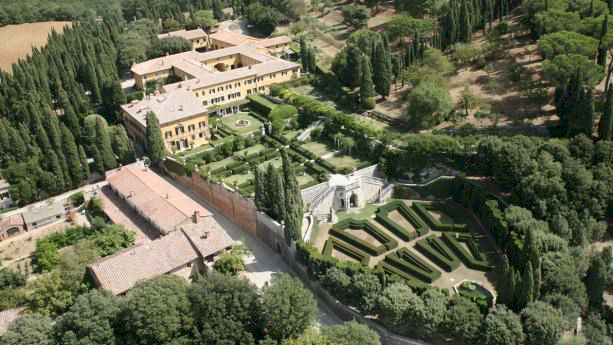
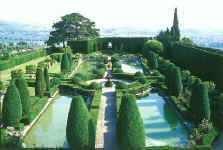
Villa La Foce and its gardens from the air Villa La Foce - the garden
The garden is divided into three distinct sections on different levels, and was created between 1927 and 1939 in several stages, without any loss of compositional unity. The part adjoining the villa spreads over two levels: the lower part, which is the simpler of the two, is enclosed by laurel bushes and decorated with lemon-tree pedestals. The upper section has double box-hedge flower-beds with a travertine fountain in the middle representing two fish holding up the basin on their tails. On the two sides next to the building is a wisteria-draped pergola supported by stone columns, and on the side diametrically opposite to it is a grotto formed from laurel trees and holm-oaks. This first sector leads, through a narrow passageway between pillars topped by two vases similar to those found along the boundary wall, to the lemon garden (a construction begun in 1933). This part of the garden, designed to follow the lie of the land, takes the form of a series of terraces towards the hill, completely altering the traditional pattern of stepped terraces symmetrically arranged around a central axis. The flower-beds, edged with box hedges shaped into hemispheres at the corners and embellished with potted lemon trees, follow the contours of the terrain. The one architectural feature, apart from the small pergola against the wall of the narrow rose garden, is the flight of steps leading to the wisteria walk and continues up to an avenue lined with cypress trees that ends at the wood. The rose garden, laid out as a series of geometrically shaped flower-beds, is bordered on one side by lavender and on the other by various perennial species. The last part of the garden, created in 1938, is connected to the lemon garden by an attractive travertine flight of steps. Underneath these steps, which are adorned with vases, obelisks and a pillared balustrade, is a space known as the "blue grotto", with seven niches inside. This formal garden, enclosed by a wall of cypresses, consists of flower-beds edged in box hedges. The beds converge on a pool, behind which is a bench made of Rapolano travertine, embellished with a statue representing Nature carrying the gifts of the earth on its shoulder. At the end of the wood is a small cemetery, in which there is small travertine chapel decorated with a Serlian motif. Iris Origo is buried here beside her husband. Iris Origo - her booksIris Origo (1902 - 1988) was the daughter of Bayard Cutting who came from an exceedingly rich New England family, with a fortune derived from the railroads and land development, and Lady Sybil Cuffe, daughter of Lord Desart, an Irish peer. In addition to being an inspired gardener, Iris Origo was a popular historian of international fame, who also wrote two autobiographical books, "Images and Shadows" and "War in Val d'Orcia", the latter excellent.
The library of Villa Le Foce
|
|||||||||||||||||||||||||||||||||||
)
)
)
)

)
)
)

)
)

)


)

)

)

